batteries · power systems · lithium-ion · robot building
Battery Selection for Robotics Projects: Li-ion, NiMH, and Alkaline Compared
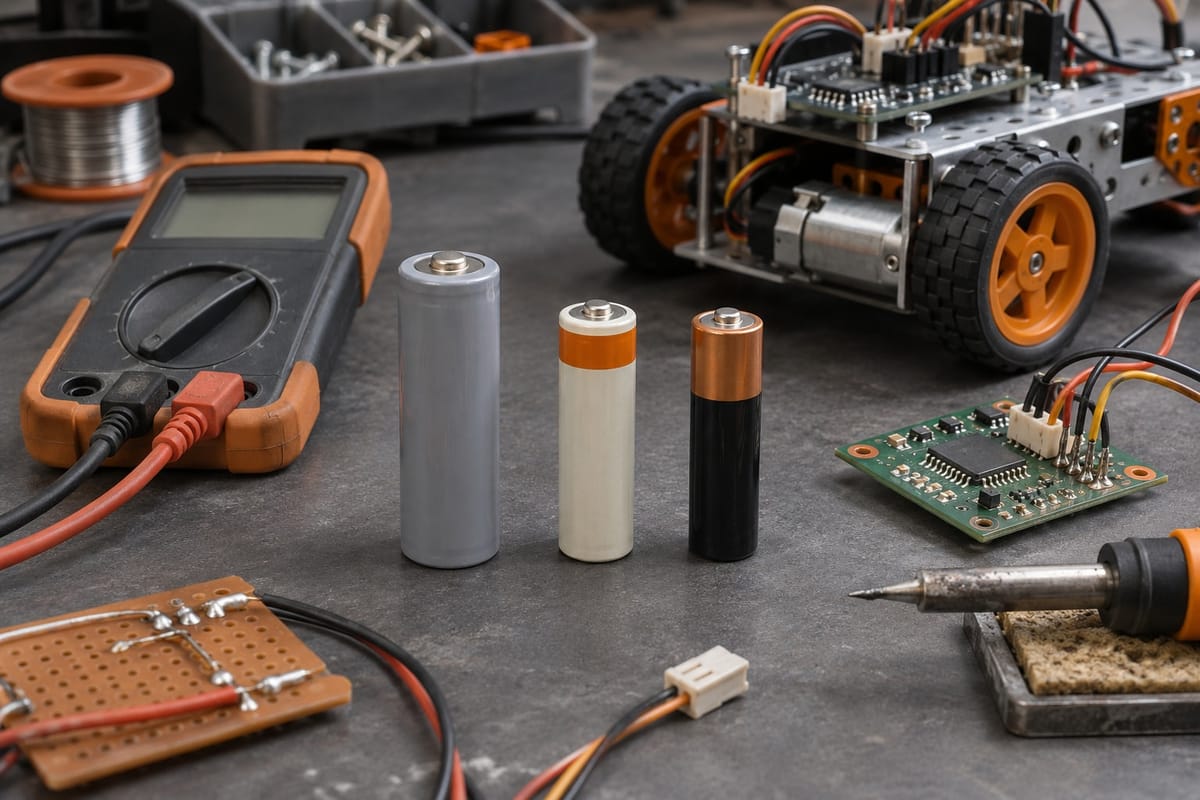
Battery choice affects every aspect of your robot's performance—runtime, weight, safety, and cost. Pick the wrong chemistry and you'll struggle with short cycles, excessive bulk, or voltage sag under load. This guide compares lithium-ion, nickel-metal hydride, and alkaline chemistries so you can match the right power source to your project's demands.
Lithium-Ion: Energy Density and Flat Discharge
Lithium-ion cells deliver the highest energy density of any common rechargeable chemistry—typically 150–270 Wh/kg. An 18650 cell weighing 45 grams can hold 2500–3500 mAh at 3.7 V nominal, giving you 9–13 watt-hours in a package smaller than your thumb. That density makes Li-ion the default for mobile robots where weight and space matter.
The discharge curve stays flat through most of the cycle: voltage holds near 3.7 V until the cell nears depletion, then drops sharply. Motors and logic circuits see stable voltage across the runtime, so you won't lose torque or speed as the battery drains. Compare that to alkaline cells, which sag steadily from the moment you switch on.
Safety and Handling
Lithium-ion cells require protection circuits. Overcharge, over-discharge, or short circuits can trigger thermal runaway—a chain reaction that vents gas, sparks flame, or ruptures the cell. Always use cells with built-in protection (look for PCB or protected in the spec) or add a dedicated battery management system when building multi-cell packs. Never connect unprotected cells directly to motor controllers or boost converters without under-voltage and over-current cutoffs.
Charge Li-ion packs with a constant-current/constant-voltage charger rated for the chemistry. A generic 5 V USB supply won't work safely unless the pack includes a charge controller. If you're assembling a pack from individual cells, balance charging is mandatory—cells in series drift over time, and an imbalanced pack shortens life and raises fire risk.
Best Use Cases
- Mobile robots and drones where weight constrains payload or flight time
- High-current applications (motor drivers, servo clusters) that need stable voltage
- Projects with frequent charge cycles—Li-ion tolerates hundreds of cycles before capacity fades noticeably
- Compact builds where space for battery packs is limited
For robots built around platforms like Raspberry Pi, a 2S or 3S Li-ion pack paired with a buck converter supplies stable 5 V or 3.3 V logic rails while still powering motors at higher voltage.
Nickel-Metal Hydride: Rugged and Forgiving
NiMH cells trade energy density for durability and safety. A typical AA NiMH cell holds 1900–2500 mAh at 1.2 V nominal, giving roughly 2.3–3 watt-hours per cell. That's about half the energy density of Li-ion by weight, but NiMH cells tolerate abuse that would destroy lithium chemistry: over-discharge to zero volts, moderate overcharge, physical shock, and temperature swings.
The discharge curve slopes gently from 1.4 V when fresh down to 1.0 V near depletion. Voltage sag is more pronounced under heavy load than Li-ion, so expect motor speed to drop as the pack drains. For applications that can tolerate this—line-following bots, educational kits, low-speed arms—NiMH offers a simpler power path with fewer failure modes.
Charging and Maintenance
NiMH cells charge via constant current with delta-V or temperature termination. Simple trickle chargers work for overnight charging, though smart chargers that monitor voltage slope prevent overcharge and extend cycle life. You can over-discharge NiMH cells without permanent damage—they'll recover when recharged—but doing so repeatedly will shorten lifespan.
Self-discharge is higher than Li-ion: a NiMH cell loses roughly 20–30% of its charge per month sitting on the shelf. Low-self-discharge (LSD) variants like Eneloop cut this to 10% per year, making them practical for robots that sit idle between sessions.
Best Use Cases
- Educational robotics where students handle batteries without strict supervision
- Prototypes and test rigs where you'd rather not worry about protection circuits
- Robots operating in cold environments—NiMH performs better below freezing than Li-ion
- Budget builds where rechargeable alkaline replacement is the priority
A six-cell NiMH pack (7.2 V nominal) powers most hobby servos and DC motors directly, and the voltage stays within the input range of common buck regulators for logic supplies.
Alkaline: Disposable Convenience
Alkaline cells are the least energy-dense and least cost-effective over time, but they're ubiquitous, shelf-stable for years, and require no charging infrastructure. An AA alkaline holds roughly 2500–3000 mAh at 1.5 V under light load, but effective capacity drops sharply as current draw rises. Pull 500 mA continuously and you'll see half the rated capacity; pull an amp and you'll get far less.
The discharge curve starts at 1.5 V and sags immediately under load, dropping to 1.2 V within minutes of use and continuing down to 0.9 V before the cell is spent. Voltage sag makes alkaline cells poorly suited for motor loads or anything sensitive to supply fluctuations. A robot that works fine on fresh cells may stall or reset once voltage dips below the regulator's dropout.
When Alkaline Makes Sense
- Low-current projects drawing under 100 mA—sensor nodes, blinky demos, remote controls
- One-off events or demonstrations where you need power immediately and can't wait for a charge
- Deployments in remote locations where replacing cells is easier than carrying a charger
- Testing and breadboarding before committing to a rechargeable solution
Alkaline cells leak when fully discharged or left installed for months, and the leaked electrolyte corrodes contacts and PCB traces. Remove cells from robots during long-term storage.
Comparing Key Specifications
| Chemistry | Energy Density (Wh/kg) | Nominal Voltage | Cycle Life | Safety Risk |
|---|---|---|---|---|
| Lithium-Ion | 150–270 | 3.6–3.7 V | 300–500+ | High (requires protection) |
| NiMH | 60–120 | 1.2 V | 500–1000 | Low |
| Alkaline | 80–150 | 1.5 V | Single-use | Very low |
Energy density figures assume complete discharge under moderate load. Real-world capacity depends on discharge rate, temperature, and age.
Matching Battery to Load
Calculate your robot's average current draw by summing the consumption of all subsystems—motors, servos, microcontroller, sensors, wireless modules. Measure peak current during the heaviest load (full-speed drive, all servos moving, Wi-Fi transmitting) and continuous current during typical operation. Your battery must supply peak current without voltage sag and hold enough capacity for the desired runtime.
A robot drawing 2 A continuous needs a battery rated for at least 2 A discharge. Lithium-ion cells specify a C rating—a 2500 mAh cell with a 1C rating can deliver 2.5 A safely; a 2C cell of the same capacity handles 5 A. NiMH and alkaline cells rarely specify C ratings, but assume NiMH can handle 1–2C and alkaline should stay below 0.5C for decent capacity.
Voltage matters too. Most motor controllers and hobby servos tolerate 6–12 V input; logic boards want 3.3 V or 5 V regulated. A 2S Li-ion pack (7.4 V nominal) sits in the sweet spot for driving motors while leaving headroom for a buck regulator to supply logic rails. A 6-cell NiMH pack (7.2 V) does the same with more forgiveness and less fire risk.
Practical Recommendations by Project Type
Lightweight autonomous rover or drone: Use a 2S or 3S lithium-ion pack for maximum energy density. Add a battery management system with under-voltage cutoff to protect cells, and use a balance charger. The weight savings and flat discharge justify the extra complexity.
Educational robot for classroom use: Use a NiMH pack in AA or sub-C cells. Students can swap packs without supervision, over-discharge won't permanently damage cells, and you won't need to explain protection circuits. Keep a few charged packs on rotation so a dead battery doesn't halt a lesson.
Stationary arm or sensor platform: If the robot stays tethered to a bench, skip batteries entirely and use a lab power supply or a wall adapter with appropriate voltage and current. If you need occasional mobility, alkaline cells work for infrequent moves or demos.
High-torque or high-current application: Lithium-ion polymer (LiPo) packs designed for RC vehicles offer discharge rates up to 20C or higher. A 5000 mAh 3S LiPo can deliver 100 A bursts—overkill for most hobby robots but essential for combat bots, heavy lifters, or anything with brushless motors. Handle LiPo packs with the same caution as cylindrical Li-ion cells: always use a protection circuit, never over-discharge, and store at partial charge in a fire-safe container.
For builders looking to compare where robotics components are sourced, battery availability and quality vary by region, but the core chemistries remain universal.
Charging Infrastructure and Safety
Every rechargeable chemistry demands its own charging profile. A charger designed for NiMH will not safely charge Li-ion, and a Li-ion charger will undercharge or damage NiMH cells. Buy chemistry-specific chargers or a multi-chemistry smart charger that detects cell type and applies the correct algorithm.
Charge Li-ion and LiPo packs in a fire-resistant location—a metal cabinet, a concrete floor, or a purpose-made charging bag. Never leave charging cells unattended for hours, and stop using any cell that swells, hisses, or gets hot to the touch. NiMH cells are far more forgiving but still shouldn't be left on a trickle charger indefinitely—overcharge generates heat and shortens life.
If you're building a robot that will be used by others—particularly in educational settings—choose a chemistry and pack design that tolerates mistakes. A six-cell NiMH pack in a hard shell with an integrated fuse is nearly foolproof; a bare 3S Li-ion pack with exposed balance leads is an accident waiting to happen.
Final Thoughts
Lithium-ion is the best all-around choice for mobile robots where weight and runtime matter, provided you're willing to manage protection circuits and charging carefully. NiMH offers a simpler, safer path for educational projects, cold environments, and builds where you'd rather not worry about thermal runaway. Alkaline cells remain useful for low-current breadboard work and one-off demonstrations but make poor economic sense for anything recharged regularly.
Measure your current draw, calculate required capacity, and choose a chemistry that matches your load profile and risk tolerance. The right battery makes the difference between a robot that works reliably and one that stalls, overheats, or catches fire. For more robotics guides and project ideas, browse our library—we cover everything from power systems to complete platform builds.